
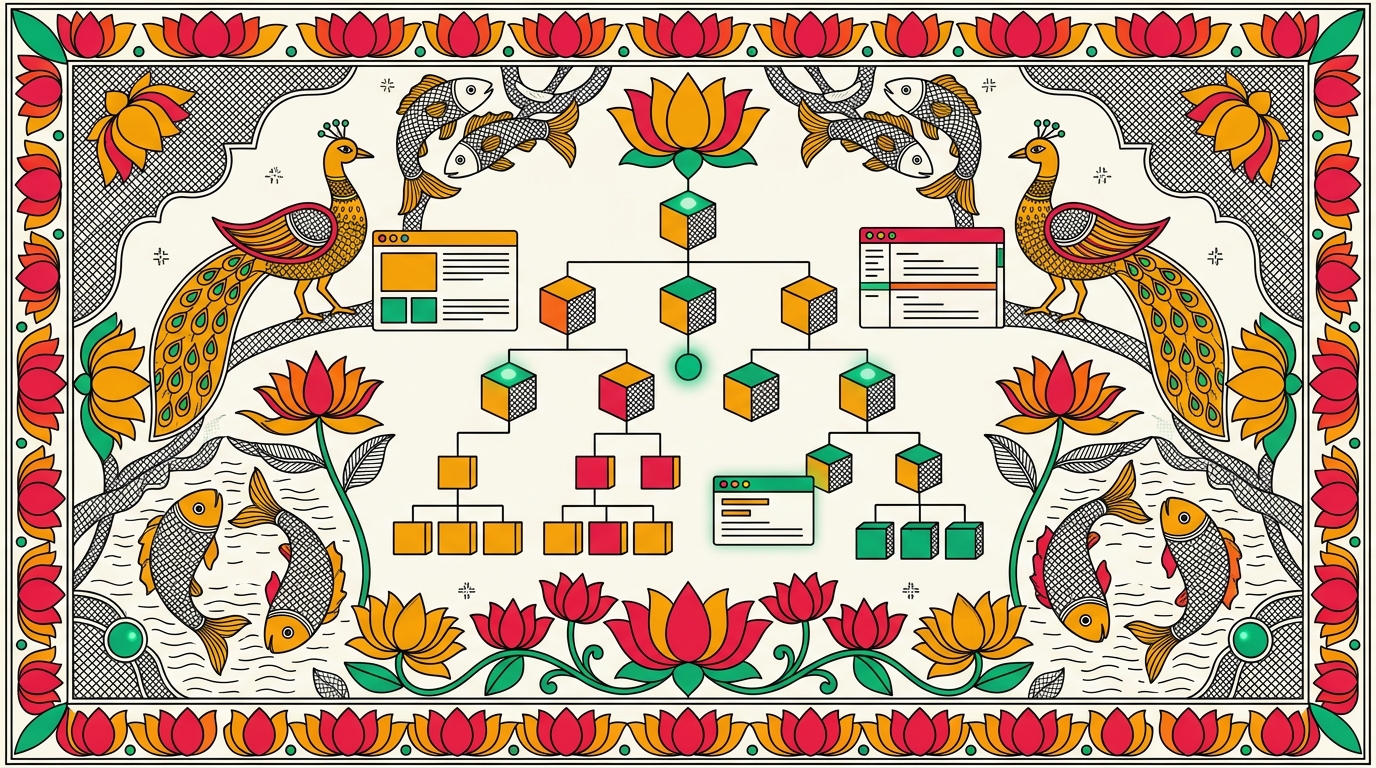
From Black-Box Packages to Machine Context: The Evolution of Web Interfaces, shadcn Mania, and the MCP Frontier
An analytical research teardown investigating the structural evolution of web design systems—from monolithic black-box npm packages to atomic headless primitives, raw source code ownership via shadcn/ui, and machine-readable MCP context engines.
Dispatch Outline & Table of Contents
An analytical research teardown of the structural evolution of web design systems from black-box packages to machine-readable MCP context engines
This comprehensive research report analyzes the structural evolution of web design systems from early monolithic npm bundles to atomic headless primitives and machine-readable MCP context engines.
01.Act I: Executive Summary & The Web Interface Paradigm Shift
Why two decades of design system abstractions collided with codebase agility and machine intelligence
For nearly two decades, frontend software engineering has been locked in a recurring structural struggle: how to achieve visual design consistency across enterprise applications without sacrificing codebase agility and developer velocity. Engineering organizations built CSS preprocessors (Sass, Less), adopted monolithic component frameworks, published enterprise design systems to private npm registries, and attempted bidirectional Figma-to-code synchronization. Yet, despite immense tooling investments, the fundamental architecture of how human developers construct—and now how artificial intelligence agents generate—user interfaces has undergone three radical paradigm shifts.
To understand why traditional component libraries fail in the age of autonomous AI coding assistants (such as Claude Code, Cursor, Windsurf, v0, and Lovable), one must trace the technical lineage of frontend UI abstractions—from compiled monolithic npm packages to atomic headless primitives, raw source code scaffolding via shadcn/ui, and AI-native MCP registry protocols.
Prior to this evolution, frontend developers faced an unavoidable trade-off between speed and control. Importing pre-built UI components provided immediate visual polish but bound the application to opaque, third-party styling abstractions. Customizing a component required fighting library-specific CSS specificity rules or maintaining brittle local forks. As applications scaled to hundreds of thousands of lines of code, this architectural tension created severe technical debt.
The emergence of AI-native engineering environments has accelerated this friction. Because compiled npm dependencies hide their internal source code, LLMs attempting to compose UIs using legacy libraries frequently hallucinate deprecated props or generate invalid inline styles that break theme contracts. Solving this problem required rethinking the relationship between design systems, source code ownership, and machine context.
To fully appreciate the gravity of the machine context shift, consider the historical pain of enterprise design system maintenance. Prior to the rise of component registries, enterprise frontend engineering organizations created dedicated core UI teams tasked with maintaining monolithic internal npm component packages. Every button variant, modal animation, or form input change required submitting pull requests to the central design system repository, waiting for peer reviews, tagging semver releases, publishing TAR packages to private artifact registries, and forcing consumer product teams to update package dependencies across dozens of distinct application repositories.
This centralized packaging bottleneck created severe Dependency Drift Across Teams. Product squads racing to meet quarterly feature deadlines resisted updating core UI package versions due to fear of breaking changes in minor semver releases. Over time, different micro-frontend applications across the same company ran on disparate versions of the design system (e.g. Squad A on v2.1, Squad B on v3.4, Squad C on v4.0). The resulting visual fragmentation negated the primary purpose of building a centralized design system in the first place.
To understand why early monolithic libraries failed at enterprise scale, one must analyze the physics of CSS cascade specificity. When a framework like Material UI or Bootstrap ships pre-compiled CSS stylesheets, it binds component styles to specific DOM selectors and class names. When a product team attempts to modify a nested component property—such as altering the border radius of an internal select dropdown menu—they are forced to write deeply nested CSS selectors or append !important flags to override bundled library defaults. As the application grows, thousands of override lines accumulate across the codebase, creating a fragile 'CSS Specificity Arms Race' where modifying one page's styling unexpectedly breaks layout components on another page.
By standardizing machine-readable registry endpoints and Model Context Protocol integrations, frontend teams eliminate visual inconsistency while giving autonomous AI assistants direct access to verified UI primitives.
02.Act II: The Monolith Era: The Tyranny of the Black Box
Deconstructing dependency lock-in, bundle bloat, and the !important CSS wars of early component libraries
In the early-to-mid 2010s, frontend application development was defined by first-generation UI frameworks such as Bootstrap, Foundation, and later Material UI (MUI), Ant Design, and Semantic UI. The initial value proposition was immensely compelling: run npm install @ui-library/core, import a <Button variant="primary"> component into your template, and instantly receive polished, cross-browser UI elements.
However, as product applications matured and enterprise brand guidelines diverged from generic library defaults, engineering teams inevitably collided with the Black Box Wall. The black-box model introduced three major structural failure modes across production codebases:
First, The !important CSS Specificity War: Customizing a component to match custom brand guidelines required writing aggressive, brittle CSS specificity overrides to beat the library's bundled CSS stylesheets. When the library updated its internal DOM node tree, client CSS overrides silently broke.
Second, Dependency Lock-In & Version Drift: Upgrading a major library version (e.g. MUI v4 to v5) frequently broke half the application due to breaking prop signature changes locked inside node_modules. Teams became trapped on deprecated library releases, unable to adopt new framework features.
Third, Bundle Bloat & Performance Overhead: Importing a monolithic component library required bundling hundreds of kilobytes of unused JavaScript runtime logic and CSS utility engines just to render basic dropdown menus or modal dialogs, severely degrading core web vitals.
Headless primitives solved the specificity crisis by completely eliminating bundled CSS stylesheets. Libraries like Radix UI and React Aria deliver raw React components that output minimal unstyled DOM elements while handling complex state machines. For example, a Radix UI Select component manages focus traps, keyboard navigation (Arrow keys, Escape, Enter), screen reader ARIA attributes, and open/close state transitions, leaving 100% of the visual styling to the application developer. When paired with Tailwind CSS utility classes, developers style primitives directly in markup using explicit utility names (e.g. bg-background p-4 rounded-xl shadow-lg).
In addition to eliminating specificity wars, the combination of Radix UI primitives and Tailwind CSS established a unified design token architecture. Design tokens—such as primary brand colors, background hues, border radii, and spacing scales—are defined as central CSS variables in a single globals.css file. Both human developers and AI assistants reference these standardized token variables, ensuring absolute visual cohesion across all application surfaces.
By deploying atomic headless components with utility-first CSS, software teams construct resilient frontend architectures that adapt seamlessly to evolving product requirements without accumulating styling technical debt.
03.Act III: The Atomic & Headless Shift
Decoupling visual styling from behavioral state machines via Tailwind CSS and Radix UI primitives
By 2020, two architectural innovations fundamentally decoupled visual presentation from component behavioral logic: Tailwind CSS (utility-first CSS) and Headless Primitives (Radix UI, React Aria, Headless UI).
Headless component libraries represented a paradigm shift in component design. Instead of shipping styled DOM elements, headless libraries provided unstyled behavioral primitives containing complex state machines, full keyboard navigation handling, focus traps, and WAI-ARIA accessibility compliance out of the box.
By combining headless state machines with utility-first CSS, developers gained 100% control over visual styling directly in markup. For the first time, engineers were no longer fighting third-party specificity rules; they constructed custom visual interfaces over battle-tested accessibility primitives.
However, assembling a full enterprise design system from raw headless primitives still required writing substantial boilerplate code across dozens of components. Teams needed a mechanism to share standardized, pre-styled headless components across projects without re-introducing monolithic npm package lock-in.
The copy-paste registry architecture popularized by shadcn/ui completely eliminated dependency drift by shifting the boundary of code ownership. When a developer runs npx shadcn@latest add dialog, the CLI fetches clean, uncompiled TypeScript source code directly from a structured JSON endpoint and writes the file directly into the local /components/ui/ directory. Because the component exists as uncompiled local source code within the product's git repository, product engineers possess 100% freedom to modify styling, extend accessibility hooks, or wire custom analytics telemetry without waiting for upstream maintainer approvals.
The registry model pioneered by shadcn/ui represents the natural culmination of this atomic trend. By serving component definitions as structured JSON metadata endpoints, shadcn created an open distribution protocol for React UI components. Developers can discover third-party registries, inspect component dependencies, and pull customizable source code into their local repositories using a unified CLI toolchain.
Comparative engineering benchmarks confirm that repositories adopting local source code scaffolding via component registries experience significantly lower refactoring overhead and zero version-drift regressions compared to codebases reliant on legacy npm UI bundles.
04.Act IV: The 'shadcn Mania': Owning the Source Code & Component Registries
Replacing third-party npm package dependencies with local CLI scaffolding and JSON registry standards
In 2023, shadcn/ui introduced a structural concept that defied two decades of web development wisdom: Do not publish an npm package. Copy and paste the raw component source code instead.
Mathematical model of AI agent context efficiency as a function of structured component schemas over prompt token consumption and MCP tool accessibility.
Instead of installing an opaque third-party dependency into node_modules, shadcn introduced a CLI scaffolding workflow (npx shadcn@latest add dialog). This command downloads raw, fully accessible, customizable TypeScript source code (built on Radix UI primitives and Tailwind CSS) and drops it directly into the project's local directory (/components/ui/dialog.tsx).
| Architectural Metric | Monolithic npm Package Model | shadcn CLI & JSON Registry Model |
|---|---|---|
| Code Location | Compiled bundle inside node_modules | Raw TypeScript files inside /components/ui |
| Customization Model | Props, CSS overrides, and !important wars | Directly edit local source code files |
| Version Drift Risk | High (breaking upstream minor updates) | Zero (decoupled git files in codebase) |
| Maintainer Bottlenecks | High (waiting for maintainer PR merges) | Zero (team owns 100% of source code) |
| Distribution Architecture | npm registry binary TAR packages | JSON Schema registry endpoints (/registry/index.json) |
This architecture triggered a widespread transformation across the web development ecosystem for three core reasons:
1. Total Code Ownership: If a modal component requires custom business logic, unique animation physics, or specialized analytics telemetry, developers edit the local file directly. There are no maintainer bottlenecks, monkey-patching, or locked abstractions.
2. Zero Version Drift: Components exist as decoupled TypeScript files within the project's git tree. Upgrading framework versions or adjacent packages never breaks UI components unexpectedly.
3. Registry Standardization: Rather than acting as an isolated UI library, shadcn established an open JSON Registry Standard (/registry/index.json). Third-party teams can host custom component registries that any CLI or AI agent can read and scaffold into React, Vue, Svelte, or Astro codebases.
Furthermore, in the era of autonomous AI software development, the JSON registry model acts as a native Machine-Readable API. When an AI coding assistant (such as Claude Code or Cursor) is tasked with building a complex dashboard layout, it does not need to analyze opaque compiled binaries inside node_modules. Instead, the AI agent queries the design system's Model Context Protocol (MCP) server, fetching exact TypeScript prop signatures, supported color variants, required sub-dependencies, and usage examples prior to generating a single line of code.
By exposing component registries through standardized Model Context Protocol (MCP) tools—such as list_shadcn_components and get_component_details—design system teams provide AI models with structured, high-signal context. The AI agent becomes an expert user of the team's internal design system, composing complex responsive user interfaces that strictly adhere to corporate design tokens and accessibility guidelines.
Ultimately, the synergy between component registries, CLI scaffolding tools, and Model Context Protocol servers transforms design systems into active participants in the AI development loop, accelerating frontend delivery while maintaining high architectural quality.
By establishing machine-readable Model Context Protocol interfaces across component registries, engineering teams guarantee that autonomous AI agents compose user interfaces with absolute fidelity to enterprise design standards.
05.Act V: The Machine Interface Era: CLI, APIs, and Model Context Protocol (MCP)
How component registries transform into AI-native context engines for Claude, Cursor, Windsurf, and v0
As AI coding assistants (such as Claude Code, Cursor, Windsurf, v0, and Lovable) shifted from basic single-line autocompletion to agentic full-stack development, traditional design systems hit a major new bottleneck.
Traditional npm-based UI libraries are invisible to LLMs. An AI model operating inside an IDE cannot see inside compiled vendor packages inside node_modules without hallucinating deprecated prop names or inventing inline styles that violate brand contracts. shadcn's registry model inadvertently supplied the exact architecture required for AI-Native Engineering.
Looking forward over the next decade, design systems will evolve from static UI component catalogues into dynamic, multi-modal context engines. Human frontend engineers and autonomous AI agents will collaborate within the exact same codebase, leveraging shared JSON registries and MCP tools to construct resilient, accessible, and beautiful web applications with unprecedented speed.
In conclusion, the evolution from monolithic npm packages to atomic headless primitives, raw source code ownership, and machine-readable MCP context engines marks a permanent milestone in web development. By bridging the gap between human design intent and machine execution, modern UI architectures empower software teams to build accessible, beautiful applications at unprecedented velocity.
Ultimately, the convergence of component registries, atomic CLI tools, and machine-readable MCP context engines creates a permanent bridge between human design vision and autonomous software composition.
06.Act VI: The Horizon: Design Systems as Machine-Readable APIs
Why the future of software creation belongs to unified human-agent design system context engines
The evolution from monolithic npm packages to atomic headless primitives, raw source code ownership, and MCP context engines marks a permanent maturation of frontend software engineering.
Design systems are no longer static Figma files or compiled JS binaries sitting inside node_modules. They have transformed into live, machine-readable context engines.
By exposing component registries through CLIs, REST APIs, and Model Context Protocol (MCP) servers, modern UI architectures allow human developers and autonomous AI agents to collaborate within the exact same codebase using a single, structured source of truth.
Looking ahead, enterprise design systems will be judged not only by their visual aesthetics in Figma, but by their Machine Context Score—how seamlessly an AI agent can inspect, scaffold, and compose their component primitives without human intervention.
07.Act VII: Canonical References & Technical Literature
Primary specifications, component registry schemas, and protocol guides
Primary documentation, component registry specifications, and protocol guides